
नाम किसके?
Whose name goes on the sale deed
The one line on the deed that families decide standing up, and the half-hour conversation that should replace it.
On this page
- The decision that gets five minutes
- Who paid, and whose name: two different questions
- Sole, joint or several: three arrangements, not three spellings
- The four questions to take to a lawyer
- The bank has an opinion about whose name it is
- Adding a name later is a transaction, not an edit
- Five things to say out loud at home
- Where the record ends and the decision begins
Your family decides, and the registered deed records whatever you decided. The law does not pick for you. One name, two names or several are three different arrangements, and each one changes who controls the land, whose signature a buyer needs, what the lender asks for and what happens afterwards. Settle it at home, weeks before the date, with a lawyer's half hour behind it.
The decision that gets five minutes
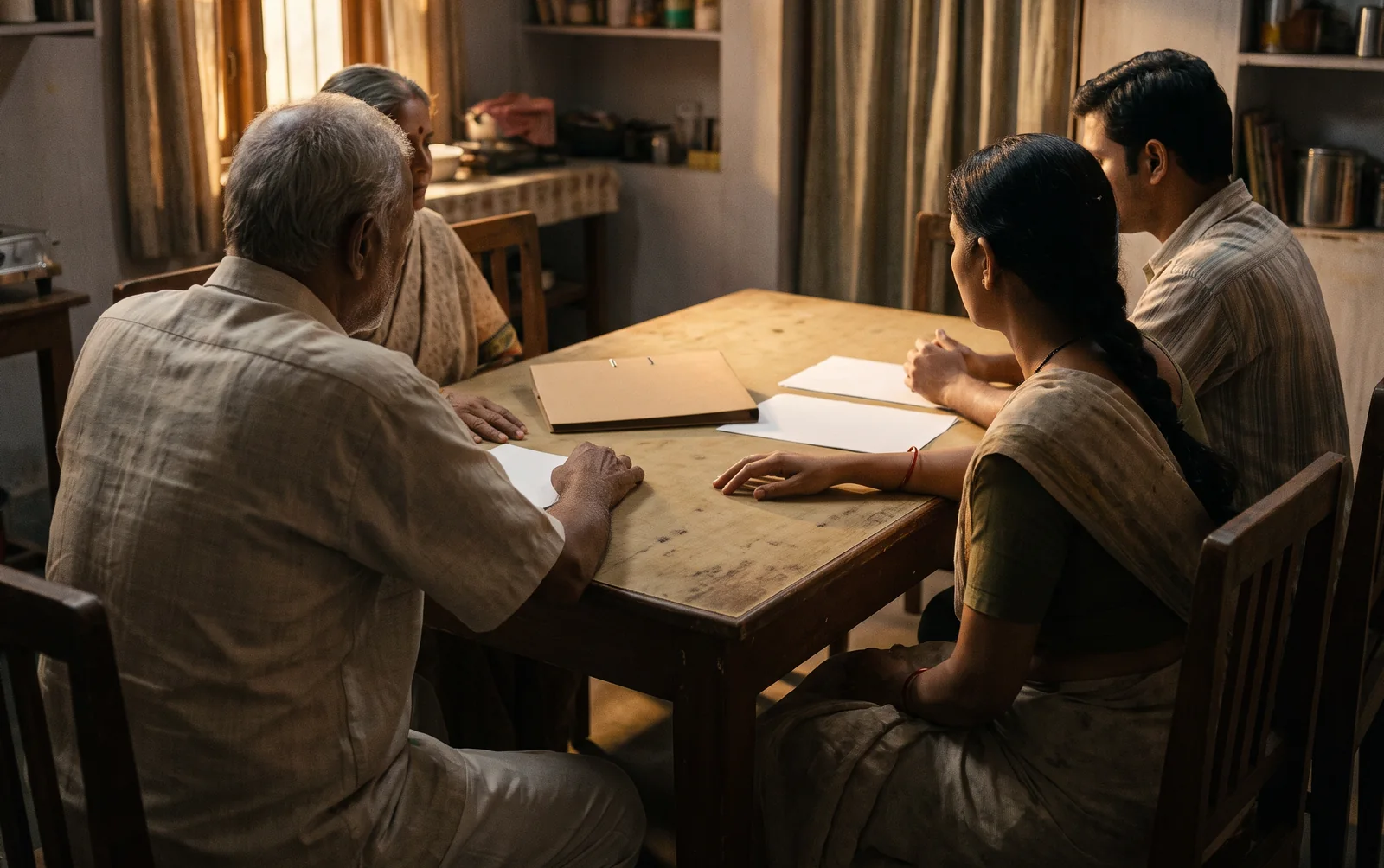
Most plots are argued over for months. The location, the price, the papers, the loan, the road outside: every one of those gets its evenings of discussion. Then, at the registration office, somebody asks whose name the deed should carry, and the family answers standing up, in a corridor, in front of strangers, with a clerk waiting.
महीनों की भागदौड़, और सबसे बड़ा सवाल आख़िरी पाँच मिनट में।
Mahinon ki bhaagdaud, aur sabse bada sawaal aakhri paanch minute mein.
The line itself is short. Under the Transfer of Property Act, a sale of immovable property worth one hundred rupees or more can be made only by a registered instrument, and that instrument names the person to whom ownership passes. It is one of the briefest lines on the document and the one the world reads for the longest afterwards.

Who paid, and whose name: two different questions
Families treat these as one thing. The document treats them as two.
Who paid is usually a mixture: savings, a loan, the sale of something else, a parent's help, a brother's share. It is a family arrangement, and it is almost always unwritten.
Who is named is a single line on a registered instrument, written once in front of the registering officer. It does not record where the money came from. It does not record what everyone assumed in the car on the way there.
The gap between those two is where trouble starts, usually years later, and usually when somebody who was in the car is no longer around to say what was meant.
पैसा किसका और नाम किसका — ये दो अलग सवाल हैं।
Paisa kiska aur naam kiska — ye do alag sawaal hain.
Sole, joint or several: three arrangements, not three spellings
| Arrangement | What it looks like on the deed |
|---|---|
| Sole | One owner named |
| Joint | Two owners on the same deed |
| Several | Three or more names, often across generations |
The difference is not cosmetic. Each arrangement changes the answer to four separate questions, and what those answers are for your family depends on facts about your family. Nobody can read them off a screen.

The four questions to take to a lawyer
This guide does not answer them, and nobody on a phone screen should. They are the agenda for one sitting with your own lawyer.
1. Control
Who decides what happens to the plot? Letting it, building on it, mortgaging it, giving permission for anything at all: whose signature does each of those need, and does anyone get a veto?
2. Selling
When you sell, the buyer's lawyer will read every name on the deed and ask whose consent the sale needs. Ask your own lawyer that question before you add a name, not after.
3. The loan
Who owns and who borrows are two different lists. The lender has its own rules about how those lists line up, and they are the lender's rules, not the law's.
4. Afterwards
What happens to the property later has more than one answer, and the answer turns on facts about your family. It is not a question for a group chat.
चार सवाल, एक बैठक — वकील के साथ।
Chaar sawaal, ek baithak — vakeel ke saath.
The bank has an opinion about whose name it is
Lenders set their own requirements for how the names on the deed and the names on the loan relate, and those requirements live in the loan terms rather than in the sale deed. They differ between lenders and between products.
One published example: a large lender, for its loan against property, requires that where the property is held jointly, every joint holder joins the loan as a co-borrower. That is one lender, one product, at one moment. Yours may say something different, which is exactly why you ask rather than assume, and why you ask while the names are still a decision rather than a document.
Adding a name later is a transaction, not an edit
Deciding now costs half an hour at your own table and a little awkwardness. Changing later is different in kind. A change in who is named on immovable property is itself an instrument: it is stamped, it is registered, and it carries its own paperwork and its own duty.
Which instrument suits your family, what it would actually cost, and whether it is the right move at all are questions for the same sitting with the lawyer. The only point here is the category: a correction is free; a change is a transaction.
बाद में नाम जोड़ना सुधार नहीं, एक नया सौदा है।
Baad mein naam jodna sudhaar nahin, ek naya sauda hai.
Five things to say out loud at home
Weeks before the date, four people, one table, half an hour.
- Who is actually buying this plot, and has anyone said so in plain words?
- Where is the money coming from, and what does each person assume that entitles them to?
- Who expects to be on the paper, and who is expected to be?
- Are we borrowing, and has anyone asked the lender what it needs?
- What do we want to be true about this property in twenty years?
The registration desk is the worst room in Indore to have this conversation for the first time. Everybody is standing, the clerk is waiting, and whatever is said in that minute is what gets written.
Where the record ends and the decision begins
Walk into that meeting knowing everything else. The colony's boundary, its sanctioned layout, its master-plan zone and the documents behind it are on the platform; as of September 2026 that is 1,161 colonies and projects and 13,352 documents. Whose name goes on the deed is the one thing on the list that is your family's decision and your lawyer's, and nothing in this guide is legal advice.
See it for yourself on the map — boundaries, plans and paperwork on one screen.
Read the colony's boundary, layout, zone and documents before the meeting →Questions people ask
Can I add my wife's name to the sale deed after registration?
Adding or changing a name on immovable property is itself an instrument that is stamped and registered, with its own duty and paperwork. Which instrument, and what it costs, is a question for a lawyer. Deciding before registration is free.
Does the person who paid for the plot have to be the person named on the deed?
Who paid and who is named are separate questions, and the registered deed records only the name. What your particular arrangement means in law is a lawyer's question, so settle it before the deed is written.
Does the bank require all owners to be on the home loan?
Lenders set their own rules on how owners and borrowers line up, and they differ by lender and product. One large bank requires every joint holder to be a co-borrower on its loan against property. Ask yours early.
What is the difference between joint and sole ownership of a plot?
One name, two names or several are three different arrangements, and each changes who controls the property, whose consent a sale needs, what the lender asks for and what happens later. The specifics for your family are for a lawyer.
When should a family decide whose name goes on the deed?
Weeks before the registration date, at home, with a lawyer's half hour behind it. Never for the first time at the registration desk.
Where the facts come from. The facts and figures in this post come from verified government sources and verified RERA-registered brokers.
Indori Zameen is a private platform. It is not a government body and is not affiliated with one — always confirm a record with the concerned authority before you commit money.
Share this post
Related posts
 Papers & law8 min read
एक दिन — और ज़िंदगी भर का काग़ज़।
Papers & law8 min read
एक दिन — और ज़िंदगी भर का काग़ज़।
Registry day: what happens, and mutation afterwards
Stamp duty, the four-month clock, Aadhaar at the counter, e-registration from home, and why a registered deed still leaves mutation to be done.
8 Sep 2025 Money8 min read
प्लॉट पर लोन
Money8 min read
प्लॉट पर लोन
Plot loans are not home loans
Less of the value funded, fewer years, sometimes a deadline to build, a tax break that waits — and a bank that checks the ground before it checks you.
8 Sep 2025 Papers & law7 min read
टोकन देने से पहले
Papers & law7 min read
टोकन देने से पहले
The token: the agreement that comes before the sale deed
The token is the first money you pay and the moment you have least on paper. Six things to put in the agreement to sell before it moves.
8 Sep 2025 Papers & law7 min read
काग़ज़ पूरे हैं?
Papers & law7 min read
काग़ज़ पूरे हैं?
The five documents that decide whether land is safe
The land is usually fine; the paper decides. The five documents that separate a plot you can build on from one you can only argue about, and how to read each.
8 Sep 2025Tagged sale-deed, registry, loan, stamp-duty, instagram-series.
Read it. Then check it on the map.
Every colony's boundary, its approved layout, its zoning and its paperwork — on one screen. Signing in is free.