
काग़ज़ पूरे हैं?
The five documents that decide whether land is safe
Colony registration, the sanctioned layout, the diversion order, the chain of registry and the khasra with its land use, in the order to read them.

On this page
Five documents decide whether a plot is safe to build on: the colony's registration, the sanctioned layout plan, the diversion order, an unbroken chain of registered sale deeds, and the khasra numbers with the land use the master plan permits there. Read each one yourself. A photocopy handed across a table is a claim, not a check.
Why the paper decides, not the land
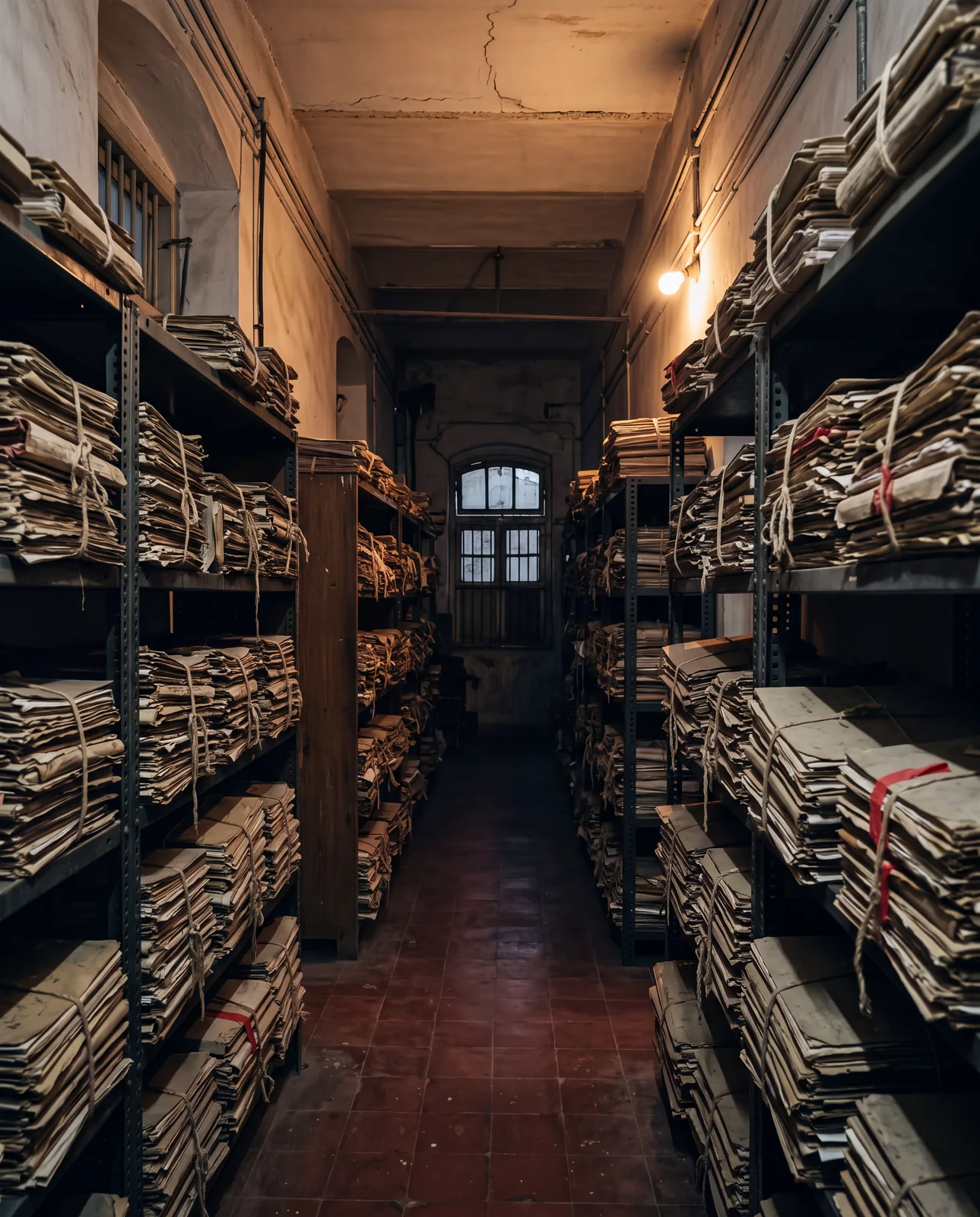
In 2025 an audit of the Indore registration department's own record room turned up suspicious documents, and an FIR followed over registries estimated at around one hundred crore rupees. The papers spanned decades, and in some of them the sellers' fingerprints were missing from the registers. Documents relating to eighteen properties were placed under investigation.
The point of that story is not any one office or person. It is that a registry can look complete and still not be real, and that the land underneath it is usually perfectly fine. What decides whether you can build is the paper.
Five papers, in this order
The order matters because each document rests on the one above it. A perfect sale deed for a plot in a colony that was never approved is a perfect record of a problem.
1. Colony registration — कॉलोनी का रजिस्ट्रेशन
Is the colony itself approved? Under the state's colony rules a colonizer must be registered, and no development or sale of plots may begin before permission to develop the colony has been granted. Everything below this line depends on it: a plot cut from an unapproved colony inherits that status however many times it is resold.
2. Sanctioned layout plan — पास किया हुआ नक्शा
The approved drawing of the colony: which plots exist, with what numbers and sizes, and which land is road, garden and public use. Your plot has to be on this sheet as a plot. If it sits where the sheet shows a road or an open space, the sale deed does not change what the sheet says.
3. Diversion order — डायवर्जन आदेश
Agricultural land has to be converted to non-agricultural use before it can lawfully be a housing plot. The order that did so is a document with a number and a date, issued under the Land Revenue Code, and the revenue record should reflect it. Houses standing nearby are not evidence of diversion; the order is.
4. The chain of registry — रजिस्ट्री की कड़ी
Not only the last sale deed, but the line of owners behind it, unbroken from the person who first held the land to the person selling it to you. Every transfer in that line — purchase, inheritance, partition, gift — should have its own registered document. A forged or missing link anywhere breaks everything after it, including a deed in your own name.
Registered documents can be searched through the state's registration portal, and an encumbrance search on the same records shows whether a loan or a charge already sits on the plot.
5. Khasra and land use — खसरा और भू-उपयोग
The survey numbers the colony actually stands on, and what the master plan permits on them. The khasra ties the colony to a specific piece of the village map; the master-plan zone says what may be built there. If the khasra numbers on the diversion order, the layout and the sale deed do not match each other, one of the documents is describing a different piece of land.
And one habit

Read them yourself. A photocopy passed to you across a table is not a check; it is the seller's claim about what the record says. The check is the record: the order from the authority that issued it, the registered deed from the registration office, the khasra from the land-records portal. Where a document has a number, look that number up at its source.
काग़ज़ पहले। रक़म बाद में।
Kaagaz pehle. Raqam baad mein.
The five at a glance
| Document | It answers | Where it comes from | |
|---|---|---|---|
| 1 | Colony registration | Is the colony approved at all? | The municipal authority under the Colony Development Rules |
| 2 | Sanctioned layout plan | Does my plot exist, and what is around it? | Town and Country Planning |
| 3 | Diversion order | Is this land allowed to be a housing plot? | The revenue authority under the Land Revenue Code |
| 4 | Chain of registry | Does the seller own it, all the way back? | The registration office and its search |
| 5 | Khasra and land use | Which land is this, and what may be built on it? | Land records and the master plan |
Every colony carries its own paper trail
Ten offices hold these documents between them. On the map each registered colony has one public page with its boundary, its sanctioned layout, its master-plan zone and the documents on file for it. As of September 2026 that is 1,161 colonies and projects and 13,352 documents from verified government sources and verified RERA-registered brokers.
Open the colony's page, read what is on file and what is not, and send it to whoever is signing with you. Then check the paper before you count the money.
See it for yourself on the map — boundaries, plans and paperwork on one screen.
Open the colony's page and see which of the five documents are on file →Questions people ask
What documents should I check before buying a plot in Indore?
Five: the colony's registration and permission to develop, the sanctioned layout plan, the diversion order, the full chain of registered sale deeds, and the khasra numbers with the master-plan land use.
What is a diversion order and why does it matter?
It is the revenue authority's order converting agricultural land to non-agricultural use under the Land Revenue Code. Without it the plot is still farmland on the record, whatever is built next to it.
How do I check the chain of ownership of a plot?
Trace every transfer back from the seller through the registered documents at the registration office, and run an encumbrance search on the same records for loans or charges.
Is a registered sale deed enough proof that land is safe?
No. A deed can be registered for a plot in an unapproved colony, on undiverted land, or with a forged link earlier in the chain. It is one of five documents, not the whole check.
What is a khasra number?
The survey number of a piece of land on the village map in the revenue record. The khasra on the diversion order, the layout and the sale deed should all match.
Where can I see a colony's documents in one place?
Each registered colony has a public page on the Indori Zameen map with its boundary, sanctioned layout, master-plan zone and the documents on file for it.
Where the facts come from. The facts and figures in this post come from verified government sources and verified RERA-registered brokers.
Indori Zameen is a private platform. It is not a government body and is not affiliated with one — always confirm a record with the concerned authority before you commit money.
Share this post
Related posts
 Buying guides7 min read
ज़मीन ख़रीदने से पहले
Buying guides7 min read
ज़मीन ख़रीदने से पहले
Five checks before you buy land in Indore, each with its red flag
Five two-minute checks on any plot in Indore — registration, khasra, zone, proposed roads, sanctioned plan — and the red flag hiding inside each one.
8 Sep 2025 Papers & law9 min read
इस ज़मीन पर किसी का हक़ तो नहीं?
Papers & law9 min read
इस ज़मीन पर किसी का हक़ तो नहीं?
The encumbrance question: is a loan or a court order already on the land?
A plot can carry a mortgage, a court attachment or a pending suit you cannot see from the gate. What an encumbrance certificate shows, and what it misses.
8 Sep 2025 Papers & law9 min read
खेत से प्लॉट तक
Papers & law9 min read
खेत से प्लॉट तक
Farmland to plots: what diversion changes, and what it does not
Diversion only changes what a parcel is assessed for on the revenue record. The two permissions that must follow, and which paper to ask for by date.
8 Sep 2025 Papers & law8 min read
काग़ज़ों के शब्द
Papers & law8 min read
काग़ज़ों के शब्द
Seven words on your papers: khasra, khatauni, diversion, FAR, mutation and more
Khasra, khatauni, diversion, layout sanction, guideline rate, FAR and setback, mutation: what each word on your plot's papers means, and why it matters.
8 Sep 2025Tagged checklist, sale-deed, encumbrance, instagram-series, layout-plan, diversion, khasra. Updated 8 Sep 2026.
Read it. Then check it on the map.
Every colony's boundary, its approved layout, its zoning and its paperwork — on one screen. Signing in is free.