
सरहद का झगड़ा।
How boundary disputes start, and the cheap half of avoiding them
Six ways a plot's line goes wrong, and the five things to do before the first course of bricks that keep an inch from becoming a court case.
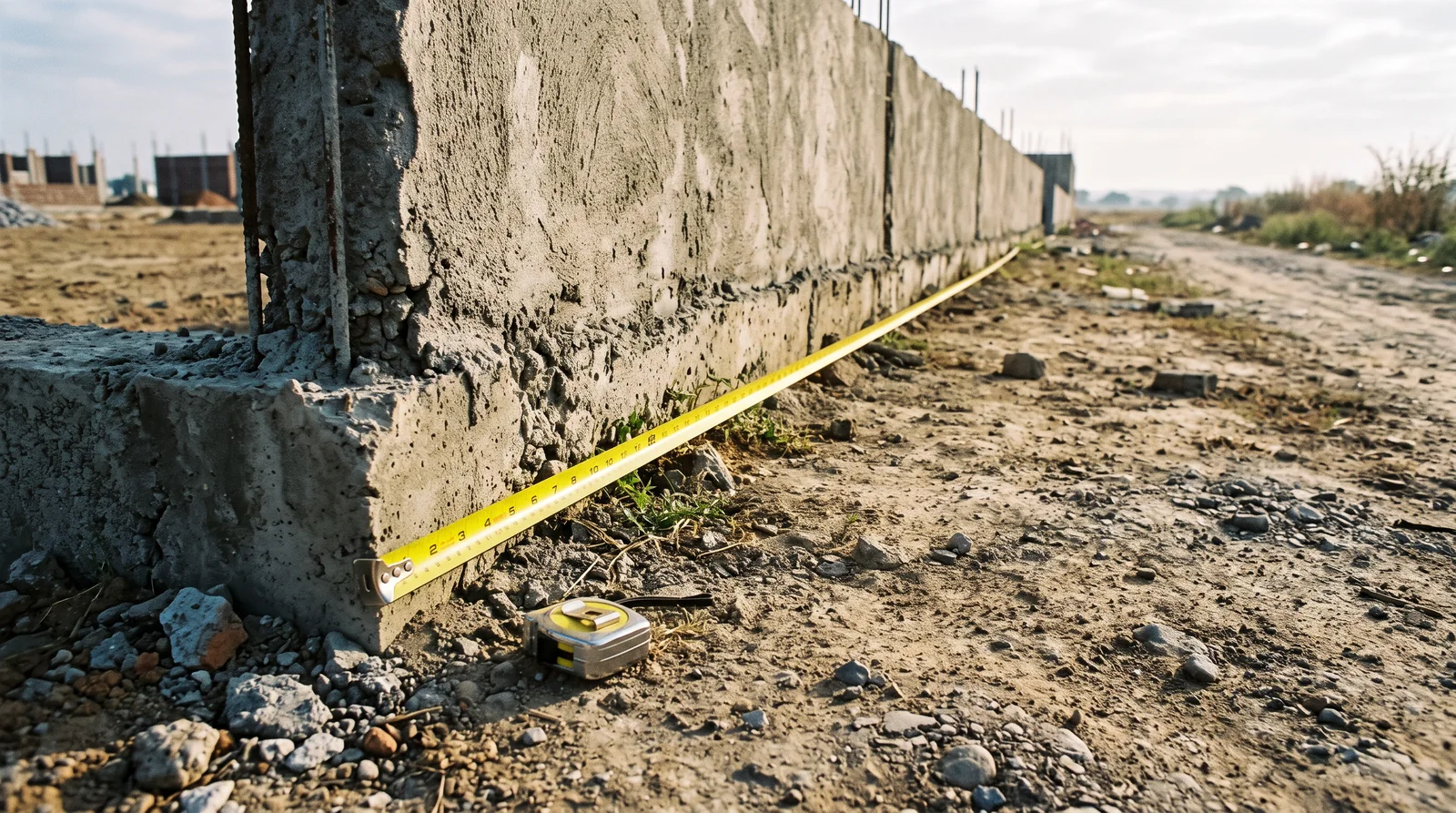
On this page
A boundary dispute almost never starts as a dispute. It starts as a few feet that two people picture differently and neither writes down, and it becomes expensive only with time. The cheap half of avoiding one is everything you do before a wall goes up: measure on the day you pay, keep the sanctioned drawing, and get the line demarcated rather than agreed by word.
It begins as a few inches
At the beginning nobody is lying. Two neighbours hold two honest ideas of where one line runs, and because both are working from memory rather than from a measurement, neither idea is written anywhere. What turns that into a dispute is not bad faith. It is the years in which a wall gets built on the difference and a house gets built against the wall.
The cost climbs in steps. While it is only a line in the dust, the difference costs one conversation. Once there is a wall on it, it costs a negotiation. Once the wall has stood for years, it is a grievance, and after that it costs professional help. The same few inches, priced at four different moments.
झगड़ा एक दिन में नहीं बनता — पहले वो सिर्फ़ एक इंच होता है।
Jhagda ek din mein nahin banta — pehle woh sirf ek inch hota hai.
Six ways a line goes wrong
1. The plot that is short on one side
A plot bought as 30 by 50 feet that measures 30 by 47. The three missing feet are 90 square feet, six per cent of the plot, and impossible to see standing at the gate. Nobody runs a tape on the day of the sale, so the shortfall stays invisible for years. It surfaces the week a mason strings a line for the plinth, one side refuses to close, and a difference nobody recorded becomes a conversation with the neighbour.
| On the paper | On the ground | |
|---|---|---|
| Length of the side | 50 ft | 47 ft |
| Area | 1,500 sq ft | 1,410 sq ft |
| Difference | 3 ft, 90 sq ft, 6% of the plot |
2. A wall built a foot over
The same foot costs three different amounts on three different days. On day one it is a peg in the dust; somebody points, somebody moves the peg, and it costs nothing. By month three it is a plastered wall, money already spent, and nobody wants to knock it down. By year five a house leans on it, and every year that has passed counts on somebody's side. The only cheap moment is before the foundation is poured.
दीवार खड़ी हो गई तो बात नहीं रही — अब सौदेबाज़ी है।
Deewar khadi ho gayi to baat nahin rahi — ab saudebaazi hai.
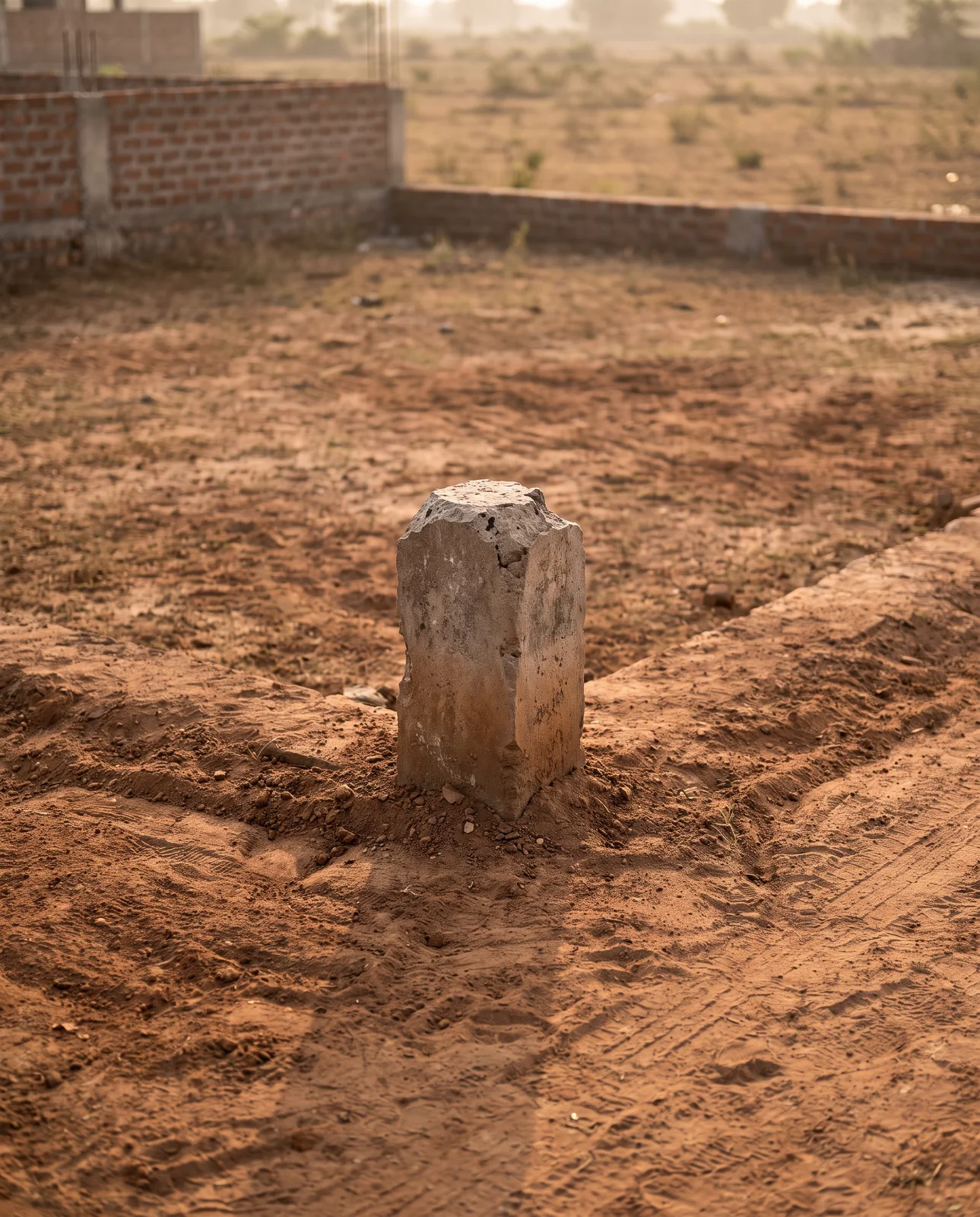
3. A corner marker that went missing
This is the quiet one. A levelling machine lifts a corner stone, or fill is dumped over it, or it simply disappears. Nothing happens that day. Two years later two families describe one line in two different sentences, and there is nothing left on the ground to settle which is right.
Boundary marks are not decoration. Under Chapter X of the M.P. Land Revenue Code, 1959, they are constructed and maintained as part of the land record, and destroying, damaging or removing one is an offence under section 130.
4. The common strip that became a road
Access land belongs to the layout, not to any plot. It gets parked on, then a wall creeps onto it, then it is spoken of as somebody's. The edge everybody shares is the edge nobody defends, which is why it is the one that goes.
5. Two drawings that disagree
The sanctioned layout says one thing; what was actually built says another. Both exist on paper, but only one was ever approved, and the difference between them sits on somebody's boundary.
6. A plot split between heirs
One holding divided into three shares on a family understanding, never demarcated again. The line is disputed inside the family long before any neighbour is involved, and by then nobody remembers who stood where.
जो झगड़ा धीरे शुरू होता है, वही सबसे लंबा चलता है।
Jo jhagda dheere shuru hota hai, wahi sabse lamba chalta hai.
A boundary is a number before it is a wall
The answer to most of these already exists. On a sanctioned layout every plot carries its number, and every run of boundary carries its length in metres. That is the line your wall is meant to follow, and it is the one figure both sides of an argument can be shown. A dispute between two memories has no referee; a dispute between a memory and a sanctioned dimension does.
Prevention: on the day you pay
- Take all four readings yourself. Photograph each with the tape still in the frame and the date on the picture. A photograph of a corner proves a place; a photograph of a tape proves a number.
- Keep the layout page that shows your plot: the sanctioned drawing with your plot number and its dimensions. Not the brochure, and not a screenshot of the brochure.
- Raise any difference before the money moves. A three-foot gap is a question while you are still deciding and a grievance once you have paid.
Prevention: before the first course of bricks
- Set out from the marks, not from what is already standing. If the marks at your corners have gone, have them put back before you build, not after.
- Get the boundary demarcated rather than agreed verbally. In Madhya Pradesh an application to the tehsildar under section 129 of the Land Revenue Code has the boundary put back on the ground with fresh marks, and a demarcation report is filed on it. A line that has been marked and written up outlasts a line two neighbours remember differently.
And if it is already a dispute
This guide covers the cheap half only. Once a wall is up and the neighbour disagrees, stop improvising and get proper professional help; the tools above are for prevention, not for litigation.
जो नाप आज लिख ली, वो कल की बहस नहीं बनती।
Jo naap aaj likh li, woh kal ki behes nahin banti.
Know the line before you draw it
Every colony on the platform is drawn to its recorded boundary, and where a sanctioned layout exists it is placed over satellite imagery so a plot's number and its dimensions can be read against what stands on the ground. Look at yours before the mason arrives.
See it for yourself on the map — boundaries, plans and paperwork on one screen.
Read your plot's sanctioned dimensions against the ground →Questions people ask
How do boundary disputes between neighbours start?
Usually as a small difference nobody measured: a plot short on one side, a wall a foot over, a missing corner stone, a shared strip walled in, a layout that differs from what was built, or a family partition never demarcated.
How do I get my plot boundary demarcated in Madhya Pradesh?
Apply to the tehsildar under section 129 of the M.P. Land Revenue Code, 1959. The boundary is put back on the ground with fresh marks and a demarcation report is filed.
Is removing a boundary stone illegal in MP?
Yes. Destroying, damaging or removing a boundary mark is an offence under section 130 of the M.P. Land Revenue Code, 1959.
What should I measure before buying a plot?
All four sides, yourself, with the tape in a dated photograph, and compare them with the dimensions on the sanctioned layout, not the brochure.
My plot measures less than the sale deed says. What now?
If you have not paid, raise it before the money moves. If you have, get the boundary demarcated and take professional advice; do not build until the line is settled.
Where the facts come from. The facts and figures in this post come from verified government sources and verified RERA-registered brokers.
Indori Zameen is a private platform. It is not a government body and is not affiliated with one — always confirm a record with the concerned authority before you commit money.
Share this post
Related posts
 Buying guides8 min read
ज़मीन पर जाकर क्या देखें।
Buying guides8 min read
ज़मीन पर जाकर क्या देखें।
The plot site visit: what to check with your feet
Walk all four sides, pace the road, return at another hour, look down and up, ask the neighbours, photograph the markers with the date on. The site visit list.
8 Sep 2025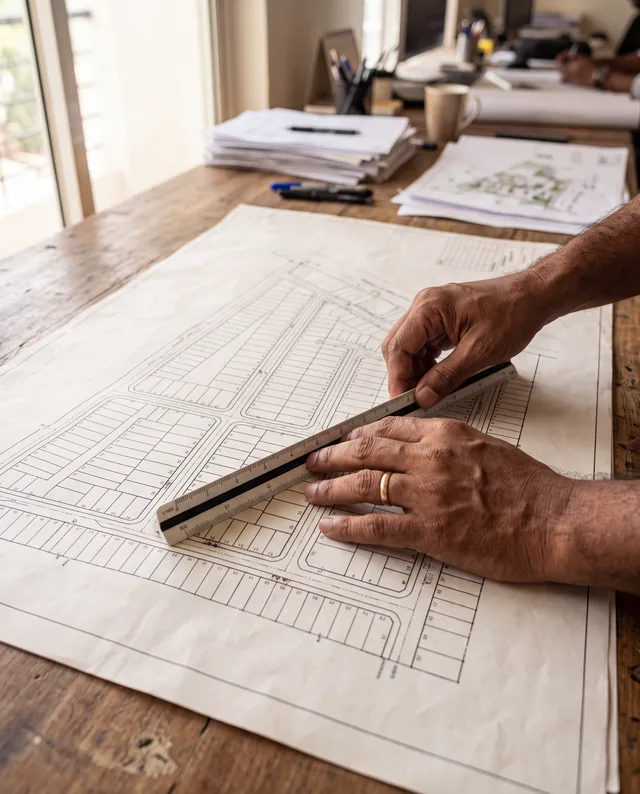 Maps & plans8 min read
नक्शा पढ़ना सीखिए।
Maps & plans8 min read
नक्शा पढ़ना सीखिए।
How to read a sanctioned layout plan
Plot numbers, road widths, open space, the reserved series and boundary lengths: how to read each one off a sanctioned layout plan before you pay.
8 Sep 2025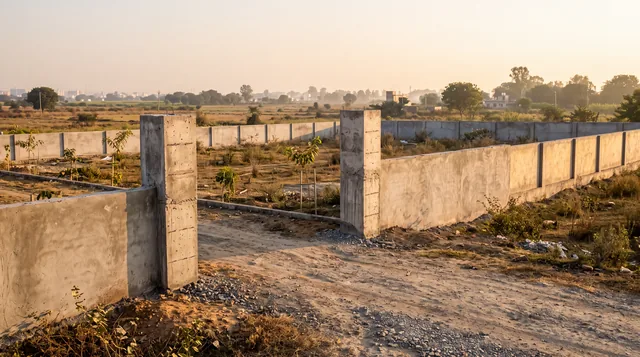 Buying guides7 min read
ज़मीन ख़रीदने से पहले
Buying guides7 min read
ज़मीन ख़रीदने से पहले
Five checks before you buy land in Indore, each with its red flag
Five two-minute checks on any plot in Indore — registration, khasra, zone, proposed roads, sanctioned plan — and the red flag hiding inside each one.
8 Sep 2025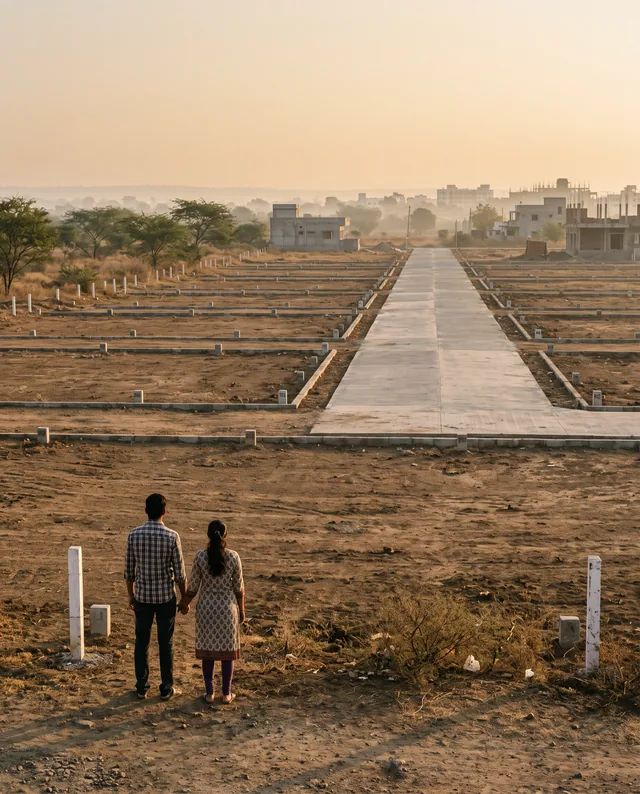 Buying guides9 min read
शुरू से क़ब्ज़े तक
Buying guides9 min read
शुरू से क़ब्ज़े तक
From first search to possession: the nine stages and how long each takes
The nine stages of buying a plot in Indore, in the order they belong, and why the token should come fifth, after the record and the ground.
8 Sep 2025Tagged boundary, site-visit, instagram-series, layout-plan, checklist.
Read it. Then check it on the map.
Every colony's boundary, its approved layout, its zoning and its paperwork — on one screen. Signing in is free.